How to Stop Someone from Reading Your Text Messages on iPhone

Russell Kent-Payne

By Russell Kent-Payne

Updated:

Your iPhone contains a remarkable amount of personal information — and your text messages are often the most revealing part.

From two-factor authentication codes that unlock your bank accounts to intimate conversations with people you trust, your messages paint a detailed picture of your life.

But if someone wants to read them, there are more ways to do it than most people realize.

It might be a jealous partner exploiting a shared Apple Account, a family member with occasional access to your device, or spyware installed without your knowledge. In many cases, the person being monitored has no idea it’s happening.

The good news is that you have more control than you might think. Most of the methods used to access someone’s messages rely on settings that can be changed, access that can be revoked, and malware that can be detected.

This guide walks you through exactly how message spying happens — and the specific steps you can take to stop it.

Make sure your messages stay private

Detect and remove iPhone spyware with the award-winning Certo AntiSpy.

Signs Someone May Be Reading Your Text Messages

Before running through the security steps below, it’s worth knowing what to look for. Common warning signs include:

  • Messages marked as read that you haven’t opened — particularly in WhatsApp or iMessage.
  • Unfamiliar devices in your iMessage or messaging app settings — a device you don’t recognize in your linked devices list is a strong indicator.
  • Settings that have changed without your input — for example, text message forwarding switched on, or a device added to your Bluetooth list that you didn’t pair.
  • Your iPhone running warmer or draining battery faster — this can indicate a background process (like spyware) is running.
  • Someone knowing the content of conversations you’ve only had by text — the most obvious real-world signal.

If you’ve noticed one or more of these, work through the steps below. And if you suspect spyware may already be installed on your device, see the final section on scanning with Certo AntiSpy — it’s the most thorough way to check.

Are you concerned about a partner or ex-partner?

If you think someone close to you is monitoring your messages without your consent, you’re not alone — and it’s not your fault. This guide will help you understand what’s happening and how to stop it.

For additional support, Certo has compiled a list of support organizations and resources at certosoftware.com/resources, including organizations in the US, UK, and elsewhere. Certo is also a member of the Coalition Against Stalkerware.

How Can I Stop Someone Reading My Messages?

Whether you’re acting on a specific concern or simply want to make sure your iPhone messages are locked down, the steps below cover the most common ways someone could be accessing your messages without your knowledge — and exactly how to stop them.

Work through them at your own pace — most take under a minute, and together they add up to a significant barrier against anyone trying to spy on your conversations.

Video: How to Stop Someone Reading Messages on your Phone

Check out this related video ⬇️


Use a strong passcode

This prevents someone who steals your phone from accessing your messages and makes it much harder for anyone to guess your passcode. The longer your passcode, the better.

According to the US Cybersecurity & Infrastructure Security Agency, you should consider using the longest passcode permissible by your device.

We recommend using a custom alphanumeric passcode, which is a combination of numbers and letters. It’s also important to avoid easily guessable combinations or sequences, like “123456” or “password”.

Warning: Avoid using passcodes based on important dates like birthdays, anniversaries. These are the first things someone will try. Instead, use a random combination that has meaning only to you.


Disable text message forwarding

This feature allows other devices logged into the same iCloud account to receive iMessages.

This is great if you are using multiple Apple devices, but if you are sharing your account with another person or family member, they will receive your messages on their device.

The best way to combat this is not to share your account with anyone. It’s much more secure for everyone to have their own accounts.

Alternatively, you can simply disable text message forwarding by tapping Settings > Apps > Messages > Text Message Forwarding.
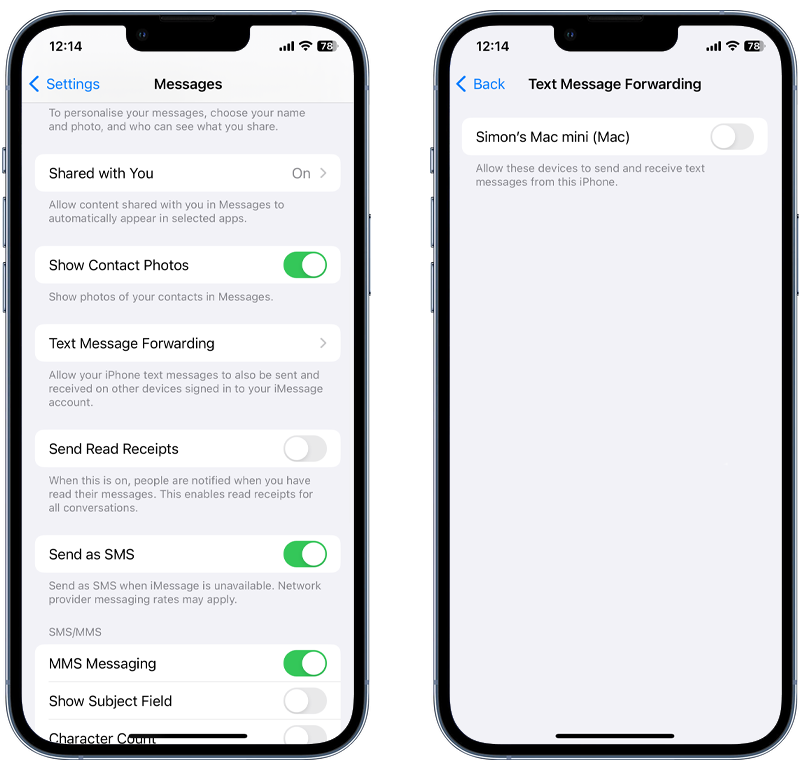
Fig 1. Disabling text message forwarding on iPhone.


Turn off lock screen message previews

Having new message previews appear on the lock screen of your device is a potential security risk. This makes it very simple for someone to just read your text messages without even having to unlock your iPhone.

To disable this feature, tap Settings > Notifications > Messages > Show Previews and change to ‘Never’ or ‘When Unlocked’.

Pro Tip: By changing to ‘Never’ or ‘When Unlocked’, you’ll still receive notifications when a message arrives. But the content will be protected when your phone isn’t near you.

Fig 2. Adjusting message preview settings on iPhone.


Check for linked devices.

Popular messaging apps like WhatsApp, Signal, and Telegram allow you to use your account on multiple devices simultaneously. While this is convenient for legitimate use, someone with brief access to your phone can secretly link their device to spy on your messages.

Once linked, they can read all your conversations – past and present – from anywhere in the world. Here’s how to check and remove any suspicious linked devices in the most popular messaging apps:

  • WhatsApp: Settings > Linked Devices.
  • Signal: Profile Picture > Settings > Linked Devices.
  • Telegram: Settings > Devices.
  • Snapchat: Profile icon > Settings > Logged In Devices.

Pro Tip: Make it a habit to check your linked devices every few weeks. If you only use one device, these lists should be completely empty. Any unexpected entries are a red flag that someone may be monitoring your messages.


Use an anti-intruder app

Apps such as iAntiTheft will allow you to use an alarm to catch or deter any would be snoopers from tampering with your phone by using different triggers to detect interference (e.g. when the device is moved or when the power cable is unplugged).


Enable two-factor authentication for iCloud

Two-factor authentication (2FA) adds an extra layer of security to your iCloud account beyond just a password. When enabled, anyone trying to log into your iCloud must enter a verification code that’s displayed on your trusted device—even if they know your password.

This prevents unauthorized access to your iCloud account, where your text messages may be synced. Even if an attacker has your account credentials, they can’t log in without physical access to your iPhone or another trusted device.

Enabling 2FA also helps block iCloud monitoring tools, which are spyware programs designed to remotely access data synced to your iCloud account, including your messages.


Check paired Bluetooth devices

Bluetooth devices paired with your iPhone could be used to read your text messages and other notifications if they have been permitted to do so.

Check for any Bluetooth devices that may have been added without your consent and remove them. To do this:

  1. Go to your Bluetooth settings (Settings > Bluetooth > My Devices).
  2. Check for any devices you do not recognize. Specifically, look for any device that has the options Show Notifications or Share System Notifications enabled.
  3. Tap Forget This Device to unpair it from your iPhone.
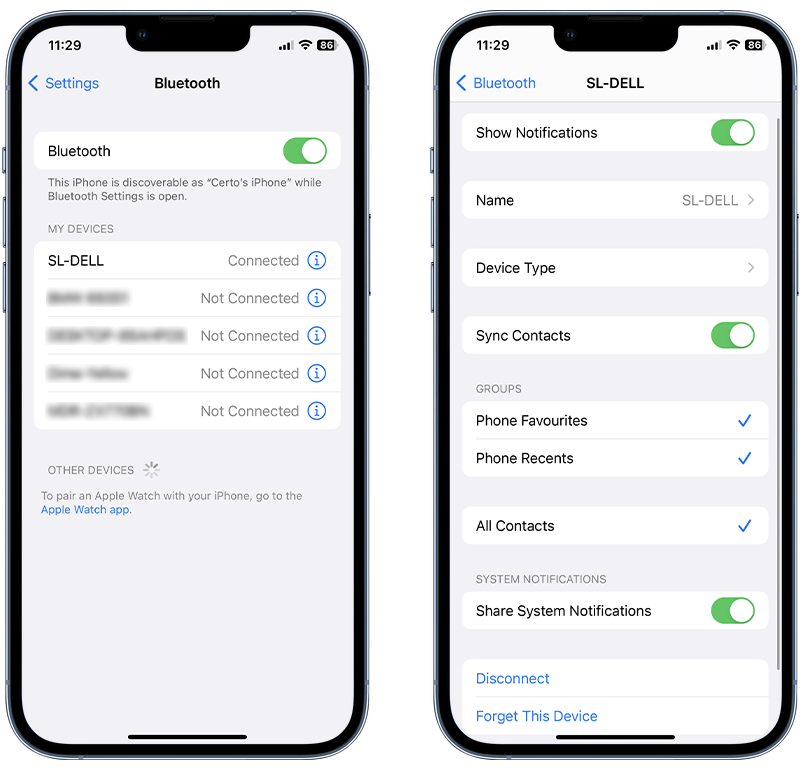
Pay special attention to any computers in your Bluetooth list—these could be using Phone Link to mirror your messages without your knowledge.

Fig 3. Checking paired Bluetooth devices on iPhone.


Use Apple’s Safety Check

If you’re in a situation where you’re concerned a partner or family member has access to your device, Apple’s Safety Check is designed specifically for you. It lets you quickly review and remove everyone who has access to your messages, location, and account data — all in one place.

To run Safety Check: go to Settings > Privacy & Security > Safety Check. From here, you can either run Emergency Reset (instantly revokes all sharing with everyone) or Manage Sharing & Access (lets you review and selectively remove access). It also lets you update your Apple Account password and trusted phone numbers in the same flow.

This is especially useful if you’ve shared your location via Find My, given someone access to your Family Sharing, or connected Apple accounts with a former partner.


Scan for Spyware on Your iPhone

The steps above help prevent unauthorized access — but what if someone has already installed spyware on your device?

That’s where Certo AntiSpy comes in. Unlike standard security apps on the App Store, which are limited by iOS to only checking what Apple allows them to see, Certo AntiSpy connects your iPhone to your computer via USB to perform a much deeper scan.

This computer-assisted approach lets it reach parts of the device that a phone-only app simply can’t access — uncovering spyware, keyloggers, and other threats that would otherwise go completely undetected.

If you’ve worked through this guide but still have a nagging feeling something isn’t right, a Certo AntiSpy scan is the most thorough way to put your mind at rest.

Removing spyware from an iPhone using Certo AntiSpy

Fig 4. Certo AntiSpy finding spyware on an iPhone.

information icon

Expert Insight: The Rising Threat of Message Interception

Modern message spying is rarely what people imagine — it’s not a distant hacker intercepting your data.

In the vast majority of cases we see, the threat comes from someone the victim knows personally: a partner, an ex, or a family member exploiting shared accounts or physical access to the device.

Based on our analysis of nearly 600,000 device scans in 2025, almost 7% of scanned devices showed medium or high security threats — many of which could have been avoided with the steps in this guide.

The most important thing you can do is use a unique Apple ID, enable a strong passcode, and check linked devices in messaging apps. These aren’t difficult steps, but they will stop the majority of message spying.

-Russell Kent-Payne, Co-founder & CEO, Certo Software

How iPhone Message Spying Happens

Understanding how someone might access your messages is often key to stopping them. The methods range from the straightforward — someone picking up your unlocked phone — to the more covert, like spyware running silently in the background. Here’s what you’re up against:

Physical access

The simplest method is also one of the most common. If someone can physically access your iPhone, even for a few minutes, they can:

  • Read messages directly if they can work out your passcode.
  • Watch over your shoulder as you type.
  • Change settings to give themselves ongoing access.

This typically happens with people you know: partners, family members, roommates, or coworkers who have regular access to your device.

iCloud exploitation

Your iCloud account is a gateway to all your synced data, including text messages. Someone can spy on your messages by:

  • Logging into your iCloud account from another device to view message backups.
  • Using a shared Apple Account (common in families) to receive your iMessages on their device.
  • Using iCloud monitoring tools if they know your credentials.

Many people don’t realize that when multiple devices use the same Apple Account, they could all receive the same iMessages.

Device pairing

Your iPhone can connect to other devices in ways that expose your messages:

  • WiFi Sync: Someone on your home network can set up iTunes WiFi sync to mirror your phone’s data to their computer without installing anything on your device.
  • Bluetooth devices: Paired devices like computers or tablets can be configured to receive message notifications, allowing someone to read your texts remotely.

These methods are particularly concerning because they work by exploiting legitimate iOS features.

Linked devices in messaging apps

Popular apps like WhatsApp, Signal, and Telegram offer “linked devices” features that let you use the same account on multiple devices. While convenient, these can be exploited:

  • Someone with brief access to your phone can scan a QR code to link your account to their device.
  • Once linked, they can read all your messages (past and present) from anywhere.

This is becoming an increasingly common method of surveillance, especially in domestic abuse situations.

Malicious apps

The most intrusive threat comes from software designed specifically for spying:

  • Spyware: Hidden apps that transmit all your phone activity, including messages, to someone else.
  • Keyloggers: Malware that records everything you type, capturing messages as you write them. Certo’s researchers have documented how third-party custom keyboards in iOS can be manipulated to secretly record keystrokes — read about this threat here.

These apps usually require physical access to install, but can then operate remotely and invisibly once set up.

SIM swap attacks

A more technically advanced method, SIM swapping involves a criminal convincing your mobile carrier to transfer your phone number to a SIM card they control. Once successful, they can intercept communications sent to your number, including:

  • SMS messages and MMS content sent to your number.
  • Two-factor authentication codes sent via text — potentially giving access to your email, banking, and social media accounts.

Note: SIM swapping only affects SMS messages (green bubbles), not iMessages. iMessages are tied to your Apple Account rather than your phone number, so they can’t be intercepted this way.

information icon

Quick note on iMessage vs SMS

iMessages (blue bubbles) are end-to-end encrypted in transit, meaning no one can intercept them between sender and recipient — not even Apple.

SMS messages (green bubbles) travel through your carrier’s network and offer weaker protection, making them more vulnerable to interception methods like SIM swapping or IMSI Catchers.

However, encryption only protects messages while they’re moving between devices. If someone has tampered with your iPhone or installed malware, they could read your iMessages directly on the device, before or after they’re decrypted.

iPhone Message Privacy Checklist

Privacy isn’t a one-time setup; it’s an ongoing process. Use this checklist to make sure you’ve covered every step in this guide, and revisit it every few months to ensure you’re always protected.

  • Set a strong, unique alphanumeric passcode.
  • Disable text message forwarding.
  • Turn off lock screen message previews.
  • Check for unfamiliar linked devices in WhatsApp, Signal, and Telegram.
  • Enable two-factor authentication on your Apple Account.
  • Review and remove any unrecognized paired Bluetooth devices.
  • Run Apple’s Safety Check to audit all account access and sharing.
  • Scan your iPhone with Certo AntiSpy to rule out spyware.

If you’ve worked through every item on this list, you’ve addressed the most common ways someone could be reading your messages. If anything flagged your attention along the way — an unfamiliar device, a setting that had changed — trust your instincts and investigate further.

Stop people reading your messages

Millions trust Certo to protect their mobile devices from hackers and cyberstalkers.

Find out how Certo AntiSpy could help secure your iPhone from illegal monitoring.