Can Someone See Your Location If Your Phone Is Off?

Published:
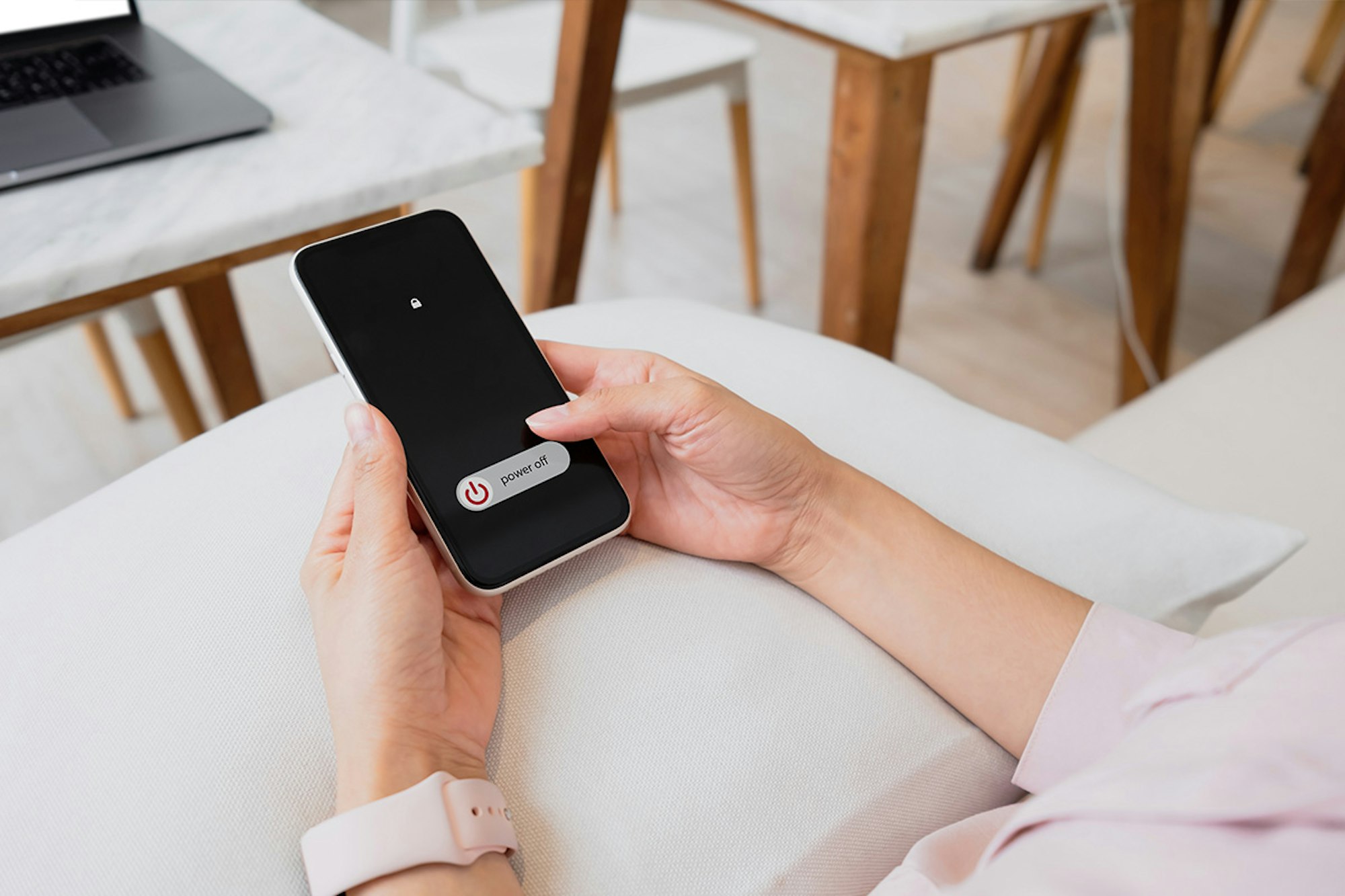
Have you ever switched off your phone because you’re worried it’s being tracked by cybercriminals?
Or perhaps you’ve lost your phone and it’s switched off or has run out of battery?
Either way, you might be wondering if your phone can be tracked when it is turned off. The short answer is yes—but only if you have services such as Apple Find My iPhone or Google Find My Device activated on your device.
Anyone trying to track your location when your phone is off will therefore need to gain access to your Apple or Google accounts.
In this article, we explore the ways someone could track your location if your device is switched off and what measures you can take to protect yourself.
Table of Contents
What Are Location Services?
Location services, sometimes called location sharing, use your phone’s GPS connection to pinpoint your device and tell you where it is. Location services sometimes also use Bluetooth, cellular, and Wi-Fi connections to work out your phone’s location.
Many apps use location services to perform their function and enhance user experience. A good example is Uber, which uses your location to connect you to nearby drivers.
However, apps like Find My on iPhone and Find My Device on Android can also use location services to find your phone, for example, if it is lost or stolen. These can be helpful tools if you’ve misplaced your device, but cyberstalkers may also abuse these services to track your location.
These apps also allow you to link your device with those belonging to other family members or friends. These are known as connected devices.
Spyware and stalkerware apps can also use location services in order to continually share your location with a hacker, allowing them to track your whereabouts.
Is your location being tracked?
Quickly and easily run a spyware check on your cell phone today with one of our award-winning apps.
Does location data work when your phone is switched off?
If your phone is switched off then all signals will be shut down. However, just before it powers off, your phone will communicate its last known location.
This happens even when it runs out of battery and it means that you still have a chance of finding your phone when it is switched off.
Both Find My for iPhone and Find My Device for Android can be used to locate phones in this way and we’ll discuss the specifics for each in the following sections.
How to Find an iPhone’s Location When Its Switched Off
Below are the steps to follow when tracking an iPhone that’s switched off. You might perform these steps if you’ve lost your device or a cyberstalker might attempt them when trying to track you.
- Use the Find My app on another Apple device. Or you can visit https://www.icloud.com/find on a computer. Enter the Apple ID and password for the device to be located.
- You’ll then be taken to a map that shows the location of devices linked to the account. Tap on the device you want to find.
- If the device is switched off or has run out of battery, it will appear with a gray dot on the map. Find My iPhone will show its last known location for 24 hours.
- If Bluetooth is enabled then the iPhone will periodically update your location in Find My, even when your phone is switched off. You can disable this option under Settings > your name > Find My > Find My iPhone > Find My Network.
- You can choose to get the iPhone to make a noise, erase it or put it into Lost Mode. The latter will lock the home screen and allow you to display a message explaining how to contact you. Of course, if the phone has run out of battery, none of these things will work until it is charged again.

Fig 1. Using Find My to locate an iPhone
How to Find an Android Phone’s Location When Its Switched Off
Below are the steps to follow when tracking an Android phone that’s switched off. You might perform these steps if you’ve lost your device or a cyberstalker might attempt them when trying to track you.
- Visit Android.com/find via a web browser.
- Sign in with the device’s Google account.
- Your device is shown at the top left of the screen.
- Select the device and its last known location will be displayed on the map.
- Unlike iPhones, it’s not possible to continue tracking the device once it’s off since Android does not have the capability to track via nearby Bluetooth devices.

Fig 2. Using Find My Device to locate an Android phone
There are many other apps for finding a lost Android phone available on the Play Store, including:
- Google Maps
- AirDroid Parental Control
- SmartThings Find (Samsung devices only)
Keeping Your Location Private
The fact that your phone gives out its location when it is switched off is great news if your phone is lost or stolen. But it’s not so good if you are worried about keeping your location private.
Some common concerns people have about others tracking their phone include:
- Stalkers or vengeful exes who could track your activity and movements
- Cybercriminals that could use your location to commit fraud
- Unwanted advertisers knowing your location
And your last known location isn’t the only way your cell phone could be tracked. Let’s look at some of the others:
Spyware
A phone infected with spyware could track your location data even if your location settings are turned off.
Worse still, it could be used to monitor your online activities. This allows criminals to steal personal information, which they can then use to commit fraud—for example, by hacking into your bank account.
Cellular towers
Cell phone towers, also known as base stations, facilitate your cellular connection by sending and receiving signals to and from mobile devices.
When you use your cell phone, signals are sent to and from the nearest cell tower. This allows your carrier to work out your phone’s location. By triangulating your signal via three different towers, your carrier can narrow down your location to a 300-meter area.
Wi-Fi
When you connect to a public Wi-Fi service, the provider will often ask you to agree to location tracking. If you do this, the Wi-Fi provider will know your location whenever you go within range of one of its hot spots.
A public Wi-Fi provider often collects visitor location data for service quality and marketing purposes. However, cybercriminals often set up fake public Wi-Fi networks. Once you connect they could monitor your Internet activity or launch more advanced attacks against your device.
Cell site simulators
Cell phones will automatically connect to the strongest cellular signal they detect. Authorities sometimes use cell-site simulators—better known as stingrays—to create a stronger signal than towers and draw traffic to them. This tricks phones into pinging the stingray. The stingray can then see each phone’s location and information.
This is often used by the police to track the movements of suspects. However, they will also attract connections from all other phones in the area.
4 Signs Your Cell Phone Is Being Tracked

Image by Freepik
Location tracking on cell phones is often an unsettling thought, largely due to its potential implications on personal privacy and security. In many cases, the leading culprit behind such a scenario is spyware.
These malicious applications are designed to surreptitiously keep tabs on your whereabouts by exploiting the GPS capabilities of your device.
However, as clandestine as these activities may seem, your phone could exhibit certain signs that may hint at the presence of such intrusive software.
1. Increased battery drainage
Spyware often forces your phone to run hidden processes in the background. This unexpected activity strains your device’s battery as it consistently sends gathered data over your cellular connection, resulting in noticeably increased battery drain.
2. Overheating
Additional activity induced by spyware not only puts pressure on the battery but could also lead to the device overheating. If your phone seems unusually hot, this could potentially indicate spyware operation.
3. Suspicious apps
To effectively track your location, malicious entities might trick you into downloading a rogue app, or stealthily install one when your phone is unattended. Be vigilant for any unfamiliar applications on your device. If you come across such apps, it’s advisable to run a thorough scan using trusted anti-spyware tools like Certo AntiSpy for iPhone or Certo Mobile Security for Android.
4. Random restarts
Spyware apps may require rebooting your phone to install updates or due to poor design causing system instability. Should your device shut down or restart without any apparent reason, it could be another telltale sign of tracking activity.
Find spyware tracking your location
Certo's award-winning spyware detection tools for iPhone and Android are trusted by millions worldwide.
8 Ways to Protect Your Cell Phone from Being Tracked
Switching off your phone provides one of the simplest and most effective strategies for preventing location tracking, as it halts signal transmission. However, this method has an evident drawback, as your phone becomes inaccessible during this period.
Here are some alternative ways to stop your phone from being tracked if you still need to use your device.
1. Avoid connecting to public Wi-Fi
Lots of public Wi-Fi networks will ask to track your location data when you sign in to them. This means that the network provider will record your location whenever your Wi-Fi picks up one of their public networks.
2. Turn location services off
Your phone’s GPS signal is the main way for other devices to track its location. Turning it off will immediately remove this option for potential cyberstalkers.
Here’s how to disable location services for iPhone:
- Open the Settings app
- Tap Privacy & Security
- Tap Location Services
- Toggle off Location Services
And here’s how to turn it off for Android phones:
- Open the Settings app
- Tap Location
- Turn off location access
3. Get a VPN
Virtual Private Networks (VPNs) create an encrypted tunnel between your device and another internet connection. This means your connection is anonymous and cannot be viewed by anyone else, making it extremely difficult to track your location.
4. Stick to official app stores
Avoid using any apps that don’t come from your device’s official app store. The apps from Google Play or Apple’s App Store have been verified by the tech provider meaning that they are more likely to be safe.
5. Install antivirus or anti-spyware software
If spyware is hidden on your phone then it may be transmitting your location and much more information from your device to criminals or cyberstalkers. You should take steps to remove it as soon as possible.
Run a quick scan with Certo for iPhone or Android now to uncover and remove malware from your phone now.
6. Check permissions
Look out for apps that make permission requests that seem suspicious or don’t fit their purpose. For example, if an app wants to access your location but has no reason to, it might want to track you. You can either delete the app or deny permissions. If you find this causes a legitimate app to not work then you can always reinstall it or reactivate the permission.
7. Update your operating system
Cyber criminals are always looking for ways to exploit weaknesses in operating systems. At the same time, tech companies constantly monitor for new threats and create security patches that can counter them. One way they do this is by releasing regular operating system updates. Installing these updates as soon as possible reduces the chances of being tracked by spyware.
8. Factory reset
Should you suspect that your device is infected with spyware and need a rapid solution to cease tracking, performing a factory reset could be an option to consider. This action wipes all data from the device, potentially eliminating any embedded spyware in the process.
However, this approach is quite radical and comes with considerable downsides. You’ll end up losing all personal data such as photos, messages, and applications. Moreover, a factory reset does not guarantee protection against tracking if your Apple or Google accounts have been compromised by malicious entities.
Protect Your Phone with Certo
Locating your cell phone when it is switched off is possible, especially if it hasn’t moved from its last known location.
However, if you’re concerned about your phone being tracked then switching it off is only a short-term solution.
The best way to protect yourself from spyware and stalkerware is to use Certo for iPhone or Android. Our advanced threat detection identifies apps that are snooping on your calls, texts, and other data.
We quickly remove threats from your device or provide you with clear instructions on how you can do this yourself. Plus, our permissions review function puts you in control of which apps can access your microphone, camera, and location.
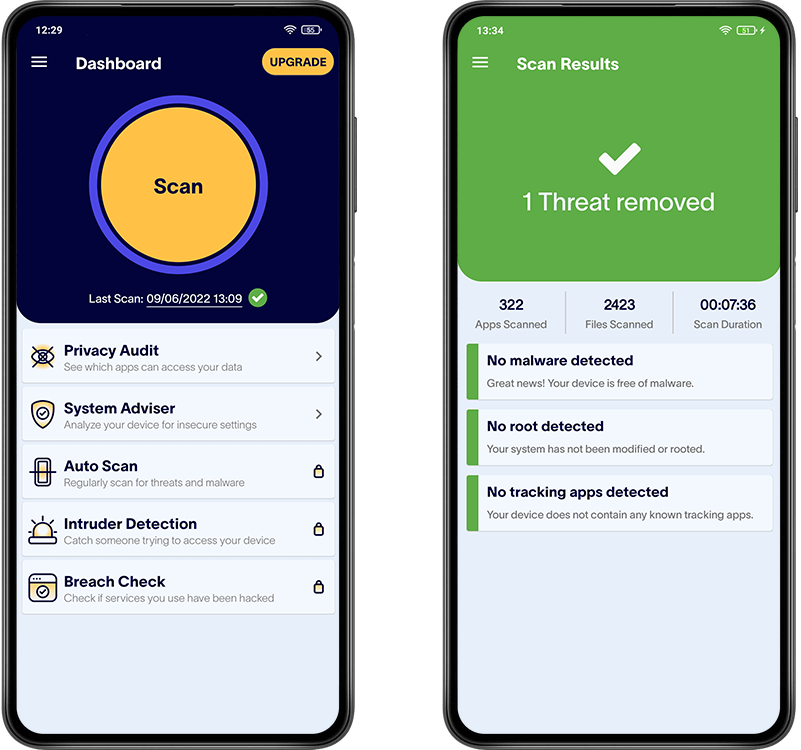
Fig 3. Certo Mobile Security for Android
Frequently Asked Questions (FAQs)
Can someone see your location if your phone is in airplane mode?
Airplane mode turns off all wireless connections on the device, including any tracking or monitoring services that rely on a data connection. This means that your location cannot be tracked in real-time.
Can you still track your iPhone if it’s battery is dead?
If an iPhone’s battery is empty, then it is impossible for anyone—including law enforcement—to physically track the device. However, if you have the Find My app active, then your phone will ping Apple’s servers shortly before it powers down, meaning that anyone with access to the device’s Apple ID account can view the device’s last known location.
How can I track my mobile location when my phone is switched off?
If you have lost your mobile device and it is switched off, you can still find it based on its last known location. If you have an Apple device, you can use the Find My app or use the Find My iPhone service on iCloud. If you have an Android device, you can use Find My Device at www.android.com/find.
Android device users also have other options such as Google Maps and AirDroid Family Locator. Samsung Galaxy users can also use Find My Mobile.
Sophia is a Senior Content Manager at Certo Software, showcasing her deep-rooted expertise as an accomplished writer in the tech industry. With a genuine passion for cybersecurity, Sophia is a trusted source of insight and information.